

A 501(c)(3) Public Charity
A 501(c)(3) Public Charity
OUR MISSION
Adagio Institute advances mathematical physics through rigorous graduate standards and foundational research, securing long-term financial autonomy for deserving work through applied econophysics and financial mathematics.
Our Research
Quantum Foundations & Stochastic Dynamics
The Physics of the Instant: Analysis from Limits, Relativity, and Renormalization
Questions dynamical completeness from first principles—the ε-δ definition of a limit, gravitational self-collapse at the Planck scale, Salecker-Wigner clock bounds, and Wilsonian renormalization—together leaving completeness at a temporal point an unproven assumption.
Koopman Spectral Theory for Indivisible Stochastic Processes
ExtenExtends Koopman spectral theory to indivisible stochastic processes—a deficit operator isolating Chapman–Kolmogorov failure, a local indivisibility tensor governing near-diagonal asymptotics, and a unitary Stinespring dilation recovering a formal Hamiltonian generator from kernel data.
Convex Perturbation and the Suppression of the Indivisibility Deficit
Derives an exact identity for the CK deficit of an indivisible kernel convexly mixed with a divisible reference; the response need not be monotone in the mixing weight, with at most one interior zero. Detectability has two thresholds, a first crossing and a bounded terminal weight beyond which violations stay below tolerance.
Selection Functionals on Path Space for Stochastic Processes Without a Generator: Finite-Grid Gibbs Selection and Self-Normalized Estimation
Reinterprets the Onsager–Machlup action as a selection functional for processes without a generator—a self-normalized importance-sampling estimator with strong consistency, two-tier finite-sample concentration, and a deficit-determined obstruction to every divisible surrogate.
Selection Functionals on Path Space for Stochastic Processes: Finite-Grid Gibbs Selection and Self-Normalized Estimation
Reinterprets the Onsager–Machlup action as a selection functional for processes without a generator—a self-normalized importance-sampling estimator with strong consistency, two-tier finite-sample concentration, and a deficit-determined obstruction to every divisible surrogate.
Memory Rank and Liftability of Transition Families Without a Generator
Converts the indivisibility deficit into a geometric invariant: the distance from an observed family to compressions of d-state hidden Markov models—a monotone liftability profile whose minimal vanishing dimension defines the memory rank, finite for every genuine finite-grid process.
Memory Production under Coarse-Graining: A Balance Law for the Indivisibility Deficit
Proves an exact balance law for coarse-graining: the Chapman–Kolmogorov deficit transmits flux, loses a severed remainder, and gains production—for Markov dynamics the Mori–Zwanzig memory kernel—vanishing at dynamically closed cuts. Memory is non-monotone under reduction.
Mathematical Econophysics & Applications
An Intuitive True Total Risk-Adjusted Performance Measure and Characteristics Matrix
Investment Measurement
Technical paper for practitioners introducing a suite of foundational metrics, including the Summers Measure and the SIC Matrix, that provide a complete, mathematically robust method of portfolio analysis.
The Standard Model of Complex Economic Systems
Investment Management
Mathematical econophysics paper composing adaptive spectral resolution, delay-coordinate reconstruction, and Koopman operator evolution into a unified forecasting framework, with prediction error factorized by stage.
Adagio Group
Mathematical physics operates on first principles and empirical proof; institutional finance largely operates on consensus and convention. Adagio Group was founded to apply the discipline of the former to the domain of the latter via OCIO relationships with family offices and endowments.
Institute Perspectives

Institute Perspectives
Funded Research Programs
Quantum Foundations & Stochastic Dynamics Grant
A competitive program supporting university-based physicists for collaboration on the Institute's active research programs in quantum foundations and stochastic dynamics. Funded researchers collaborate as co-authors on the Institute's publication pipeline, with joint institutional affiliation on all resulting work.
Academic Programs
Degree Programs
Adagio Institute currently offers a Doctor of Philosophy in Mathematical Physics through either a course-intensive or a published works pathway and is exempt from Florida Commission for Independent Education licensure pursuant to Sections 1005.02(6) and 1005.06(1)(d), Florida Statutes. The Institute is not currently accredited, and the program is offered exclusively to employees of Adagio Group.
Ph.D. in Mathematical Physics with Concentration in Stochastic Quantum Theory
A doctoral accreditation standard designed to produce the world's most rigorously trained theoretical physicists. The core mission is to cultivate a Penrose-level mathematical mastery of physical law, understood not as a set of empirical rules but as a single, unified mathematical structure. The graduate curriculum is uncompromising in its rigor, guiding students from the symplectic geometry of classical mechanics and the differential geometry of field theories to the C*-algebraic formalism of quantum and statistical mechanics. The objective is to produce physicists with a first-principles command of physical law that surpasses that of the world's top academic programs. We recognize, however, that the traditional academic path is not the sole ambition of every brilliant physicist. For those seeking to maximize the economic value of their expertise, we have created the optimal nonacademic pathway.
Doctoral Examination Reports


THE ACADEMIC DIRECTORS










Dr. Benjamin D. Summers
Executive Director - Mathematical Physics
Ben is a researcher in mathematical physics and the principal investigator at Adagio Institute, Inc. His research focuses on quantum foundations and stochastic dynamics, applying operator-theoretic and path-integral methods to complex systems via mathematical econophysics.
To support foundational scientific inquiry, he established the applied mathematical econophysics research institute as a financially autonomous 501(c)(3). The Institute achieves a "quasi-sovereign" funding model via Adagio Group, the vertically integrated OCIO platform where he serves as managing director. His research direction and first-principles framework provides the quantitative engine for the firm's portfolio management and the analytical foundation for its comprehensive services—from investment policy development to robust, data-driven governance—for the family office and endowment space.
Ben holds a BS in Physics from Louisiana State University and a PhD in Mathematical Physics with a research focus on stochastic quantum theory. He is a member of the American Physical Society, Philosophy of Physics Society, Forbes Finance Council, and author of the bestseller, The Shadow Banker's Secrets: Investment Banking for Alternatives.

Ezequiel leads advanced research and development in mathematical and physical modeling. He also serves as an Adjoint Professor in the Department of General Relativity and Gravitation at FaMAF, National University of Córdoba (“UNC”), Argentina. His academic work integrates rigorous theoretical frameworks with computational methodologies, supporting the institute’s transdisciplinary scientific initiatives.
In addition to his academic appointments, Ezequiel has accumulated more than fifteen years of independent research experience and over seven years as a scientific consultant to the private sector, bridging the gap between theoretical insight and real-world problem-solving, fostering collaboration between academia, research institutes, and industry.
Ezequiel received his Ph.D. in Theoretical Physics, with a research focus on general relativity, cosmology, and astrophysics. His expertise spans mathematical physics, numerical methods, scientific modeling, statistical analysis, and data interpretation. He has led and contributed to diverse international research projects, with results published in leading Q1 peer-reviewed journals in the fields of cosmology and astrophysics.

PAPERS
Memory Production under Coarse-Graining: A Balance Law for the Indivisibility Deficit
July 2026
Memory Rank and Liftability of Transition Families Without a Generator: A Projection Theory for the Indivisibility Deficit
July 2026
We call a two-time family of transition kernels on a finite state space flat when it satisfies the Chapman–Kolmogorov property, and we read flatness as a flat transport over the complex of time intervals. This paper develops the geometry of families for which flatness fails; such a family admits no time-local Markov generator on the observed state space. The defect Δ(t,s,r) is the intrinsic failure of the Chapman–Kolmogorov property; it is a kernel-valued 2-cochain, and associativity of composition imposes on it a coherence identity of Bianchi type. A first result closes the natural route to an invariant: under the invertible mass-preserving re-dressings admissible for a family, the orbit closure of every family contains flat families, so no orbital minimization of a flatness distance defines an invariant. The invariant is built from dilations instead. Within a declared dilation class, F_d denotes the compact semialgebraic closure of the set of compressions of flat transports on d hidden states with positive block masses. The liftability profile h_d(V), the attained distance from V to F_d in a weighted metric on families, is nonincreasing in d and 1-Lipschitz in the family, and its zero stratum consists of the families approximable to arbitrary precision by such compressions. On a grid of m+1 times with n observed states the model sets stabilize: every conditional family of a process on the grid lies in F_D for an explicit D ≤ D_max = ∑{k=0}^m n^{k+1}, so F_d = F{D_max} for every d ≥ D_max, the union of the model sets is closed, and the profile of every family in the closure of the process-induced families vanishes at a dimension at most D_max. The memory rank, the minimal vanishing dimension, is thus finite exactly on that closure. Two linear programs bound the profile from below: the marginal-consistency defect and the joint-law defect; the second vanishes on the closure of the process-induced families, characterizes the process-induced families through the support of its optimal laws, and detects families that the first does not. First-order conditions at the projection are stated on the tangent and normal cones of the strata. The profile is class-relative: passing from time-homogeneous to time-inhomogeneous lifts weakly decreases it and decreases it strictly on explicit families at the dimension-matched level. Exact examples close the paper: a family whose profile is bounded below at every dimension by a direct evaluation of the obstructions, a family with consistent marginals and no joint law, a lumped chain whose memory rank lies strictly below its generating dimension, and the class gap in closed form.
Selection Functionals on Path Space for Stochastic Processes Without a Generator: Finite-Grid Gibbs Selection and Self-Normalized Estimation
June 2026
We develop an estimation theory on finite-grid path space for stochastic systems whose two-time transition families violate the Chapman–Kolmogorov factorization and therefore admit no generator on the observed state space whose evolution reproduces the given family. Candidate paths supplied by an external proposal mechanism are reweighted by the exponential of a discretized Onsager–Machlup (OM) action computed against a tractable surrogate model that is explicitly not the truth, and expectations under the resulting Gibbs-selected measure are estimated by self-normalized importance sampling (SNIS). Up to a constant and the OM divergence term, the selection weight is the surrogate's own discrete path density raised to the temperature, so the selected measure is a product of two path densities rather than the density ratio used by Girsanov reweighting; this identity is the construction's point of departure from the path-reweighting literature. For Gaussian pairs the product adds precisions to leading order in the grid step δt: the selected measure acquires the diffusion coefficient 1/σ_eff² = 1/σ_Π² + λ/σ_ν² + O(δt), different from the proposal's for every temperature λ > 0, and this quadratic-variation mismatch is the mechanism behind every degeneracy the paper reports—the chi-square divergence between selected measure and proposal grows exponentially under grid refinement, the selected measures converge to a continuum law that is singular to the proposal's, and the finite grid is the primary setting because the importance-sampling representation of the selected measure from the proposal does not survive refinement. The estimator theory is standard SNIS theory specialized to this weight and is stated as such: strong consistency, a central limit theorem, finite-sample concentration in two tiers (polynomial under finite chi-square divergence, exponential under bounded weights), and degeneracy diagnostics organized by the chi-square divergence. The relation to the true process is a conditional transfer under an explicit total-variation hypothesis, flanked by an unconditional kernel-level obstruction bounding, under a contraction hypothesis, every divisible surrogate family away from an indivisible target; the two are logically independent, and under grid refinement the hypothesis is attainable only for proposal–surrogate–temperature triples designed to the target's quadratic variation. Surrogate calibration is formulated as Euler quasi-likelihood estimation, and the inconsistency of calibrating by the OM action itself is recorded. Two fully worked one-dimensional examples are given: a Gaussian pair in which every quantity is in closed form, and a double-well surrogate with non-constant drift divergence in which the benchmark is obtained by transfer-matrix quadrature and the divergence term measurably changes the estimand.
Convex Perturbation and the Suppression of the Indivisibility Deficit
June 2026
We study how the Chapman–Kolmogorov (CK) deficit of a column-stochastic two-time family {Γ(t←s)}{s≤t} on a finite state space responds to convex mixing with a divisible reference family, Γ_g = (1−g)Γ_0 + gΓ_ref, g ∈ [0,1] — the simplest fixed-weight convex perturbation of an indivisible family. The organizing result is an exact identity for the deficit operator of the mixed family, Δ(t,s,r;Γ_g) = (1−g)[X − gK], where X = A − CE is the substrate deficit and K = (C−D)(F−E) is a substrate–reference interaction term assembled from the kernels on the three subintervals of the triple; the operator-norm bound D(t,s,r;Γ_g) ≤ (1−g)D(t,s,r;Γ_0) + g(1−g)M(t,s,r) follows. Because the identity is exact, the deficit up to temporal scale δt equals (1−g)S(g) for a convex function S; the response need not be monotone in g, can vanish at one interior coupling, and can rebound. This forces a two-threshold formulation of detectability: a first-crossing threshold g_first(δt;ε) and a terminal suppression threshold g_term(δt;ε) beyond which the deficit remains below a detection level ε at every stronger coupling. We prove 0 < g_first ≤ g_term ≤ g_1 ≤ g_0 < 1 with g_1 = 1 − [D_CK + M* − √((D_CK + M_)² − 4M_ε)]/(2M_) and g_0 = 1 − ε/(D_CK + M_), where D_CK is the unperturbed deficit up to scale δt and M_* the interaction scale; the bound g_1 is attained by an explicit configuration, so no bound in D_CK and M_* alone improves it. The sufficient couplings tend to 1 as ε → 0; exact vanishing is guaranteed at g = 1 and possible at no more than one interior coupling. A two-state family exhibits the interior zero, the rebound, and, for tolerances below the rebound peak, the separation of the two thresholds at the scale level. Secondary results, stated in the body, are an interval-local stability lower bound on g_first, quadratic suppression of the integrated deficit, and a rigorous bound for state-dependent coupling. The families are treated as abstract two-time transition families; no claim is made that the mixture is realized by a particular measurement or control protocol.
Koopman Spectral Theory for Indivisible Stochastic Processes
May 2026
The operator-theoretic analysis of stochastic dynamics standardly assumes a transition kernel satisfying the Chapman–Kolmogorov (CK) factorization, which equips the two-time operator family with the cocycle structure on which generator-based spectral theory rests. We develop spectral machinery for two-time transition families that violate this condition irreducibly—indivisible families—for which no time-ordered-exponential generator in the Dyson (Bochner-integrable) class exists. The framework operates on the forward family {P(t,s)}, s ≤ t, on L²(Ω,μ) through the singular structure of its composition deficit Δ(t,s,r) = P(t,s) − P(t,r)P(r,s), not through eigenexpansions. Two results organize the paper. Locally, an indivisibility tensor β(s) = C(s) − L(s)² − L′(s), computed from second-order Taylor coefficients at the diagonal, governs the exact leading-order scaling Δ(t,s,r) = (t−r)(r−s) β(s) + o((t−s)²); its vanishing is necessary for divisibility of a jointly C² family, and β(s₀) ≠ 0 forces CK failure near s₀. Globally, closed deficit subspaces V_in, V_out concentrate the failure of factorization—every deficit operator vanishes on the orthogonal complement of V_in—and, under a standing contraction assumption, a universal three-pair bound places every divisible comparison family at operator-norm distance at least D(t,s,r)/3 from the family at the worst single time pair, a constant that cannot be improved. Covariant eigenfamilies with non-multiplicative multipliers witness indivisibility; an integrated deficit on the trajectory space L²([0,T] × Ω) vanishes exactly under divisibility; each two-time map admits a Stinespring dilation on a fixed dilation space, jointly continuous in (t,s), with a measurable formal Hamiltonian generator under explicit regularity, and divisible families admit an exact cocycle dilation on every finite time grid. In any selected unistochastic gauge the deficit splits exactly into an interference cross-term plus a non-composition term; only the sum is gauge-invariant. Worked two- and three-state families, including one with V_in ≠ V_out, exhibit the constructions in closed form.
The Physics of the Instant: Analysis from Limits, Relativity, and Renormalization
March 2026
Much of theoretical physics rests on the idealization that a physical system possesses a complete state at each instant of time, a state sufficient to determine its future evolution. We argue that this completeness is a physical assumption rather than a consequence of how the instantaneous state is defined, and that established physics provides no basis for it and positive reasons to doubt it. Three independent lines of evidence are assembled. First, operationally the state at a temporal point is the continuous extension of descriptions over finite intervals: the ε-δ definition of a limit assigns a value at the point from its punctured neighborhoods, and whether that value is dynamically sufficient is a property of the dynamics that the construction neither supplies nor guarantees. Second, quantum mechanics and general relativity, applied jointly, bound spatial and temporal resolution at the Planck scale, and the Salecker-Wigner clock bound, combined with the requirement that the clock itself not undergo gravitational collapse, yields the same temporal bound from the properties of the clock rather than of the probed region. These bounds are not theorems of a completed theory of quantum gravity, but within the semiclassical domain in which they are derived they obstruct the limiting process δt → 0. Third, in quantum field theory products of field operators at coincident points are singular, an effective description carries a validity scale beyond which it fails, Wilson's analysis makes renormalization a feature of the theory rather than a defect of perturbation theory, with a continuum limit requiring an ultraviolet fixed point of the flow, and the algebraic formulation assigns observables to open regions rather than to points and fixes the dynamics from any neighborhood of a Cauchy surface while assigning no algebra to the surface itself. Taken together, these show that completeness at a temporal point is not delivered by the construction of the state, is not reachable by measurement within the domain of established physics, and is not where established theories place their physical content. Dynamical completeness is defined for the deterministic and the stochastic settings, and the descriptions that presuppose it, the uniquely solvable initial-value problem and the Markov property, inherit the assumption. For an irreducible finite-state Markov chain in its stationary law, the composition defect of its temporal window average vanishes at least linearly with the window width, which yields a one-sided test of memorylessness on the observed state space. The memoryless description is the special case that requires justification.
The Standard Model of Complex Economic Systems: A Unified Framework for the Adaptive Resolution, Reconstruction, and Evolution of Market Signals
March 2025
(This paper presents the comprehensive theoretical and empirical framework underlying Adagio Group's investment strategies.)
We present the Standard Model of Complex Economic Systems, a purely theoretical framework in which the forecasting problem for financial signals factorizes through three stages. First, an adaptive spectral resolution, characterized axiomatically rather than by any basis fixed in advance, resolves the observed signal into frequency-ordered components and a residual. Second, each component is treated as a scalar observable of an underlying subsystem and lifted to a reconstructed state space by delay coordinates, with validity governed by embedding theory and, for stochastic components, by minimal Markovian realization. Third, each reconstructed component is evolved through the spectrum of a finite linear representation of its Koopman operator, and the composite forecast is recovered by recombination. We prove that the prediction error of any causal forecast admits an irreducible floor that depends on the process and the horizon and not on the architecture. The functional extensions of the Omega ratio and the Summers Total Risk-Adjusted Performance Measure serve as the framework's evaluation functionals. The framework is presented at the level of the architecture: particular numerical instantiations are proprietary, and no empirical results are reported.
An Intuitive True Total Risk-Adjusted Performance Measure and Characteristics Matrix
January 2023
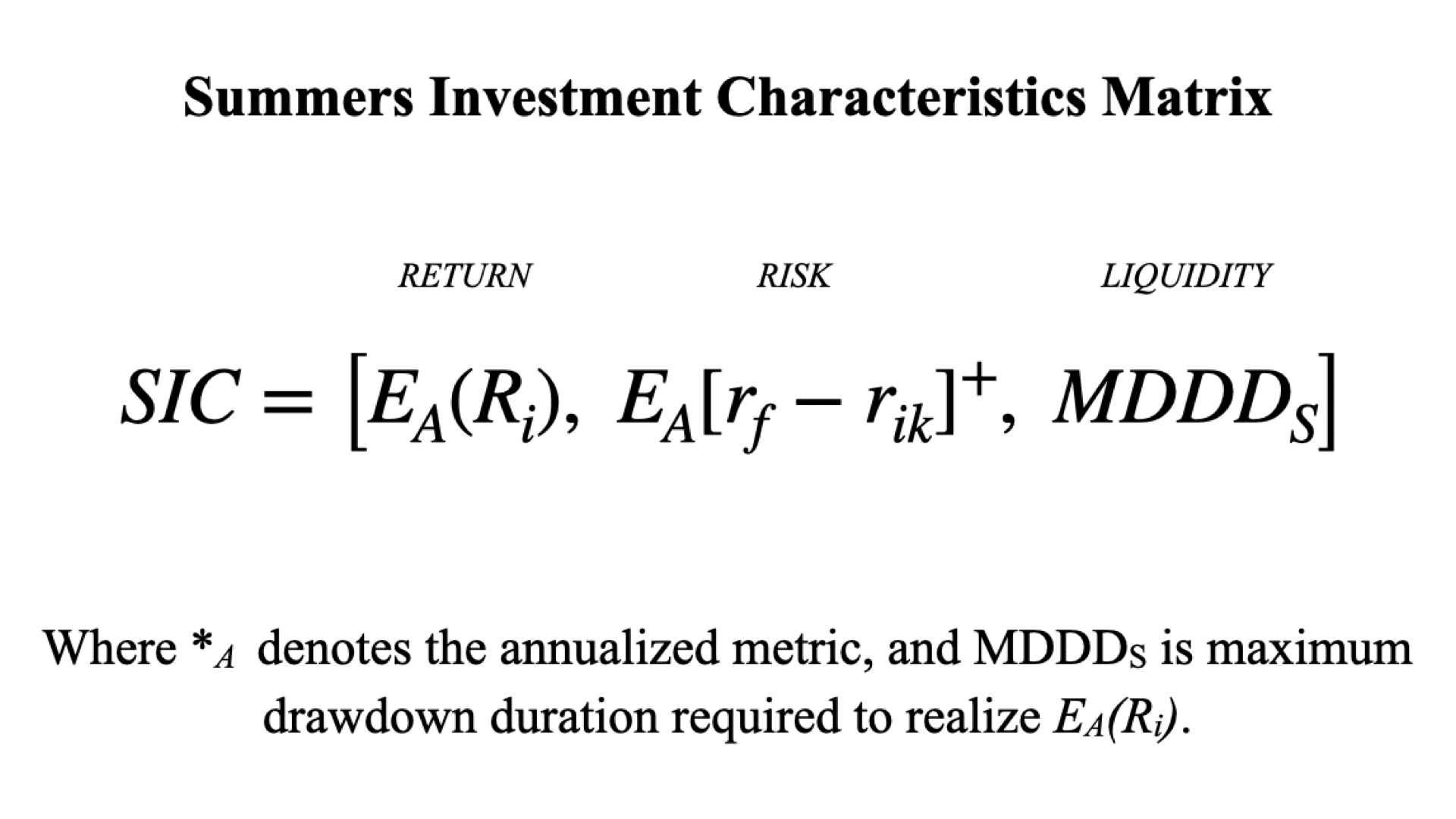
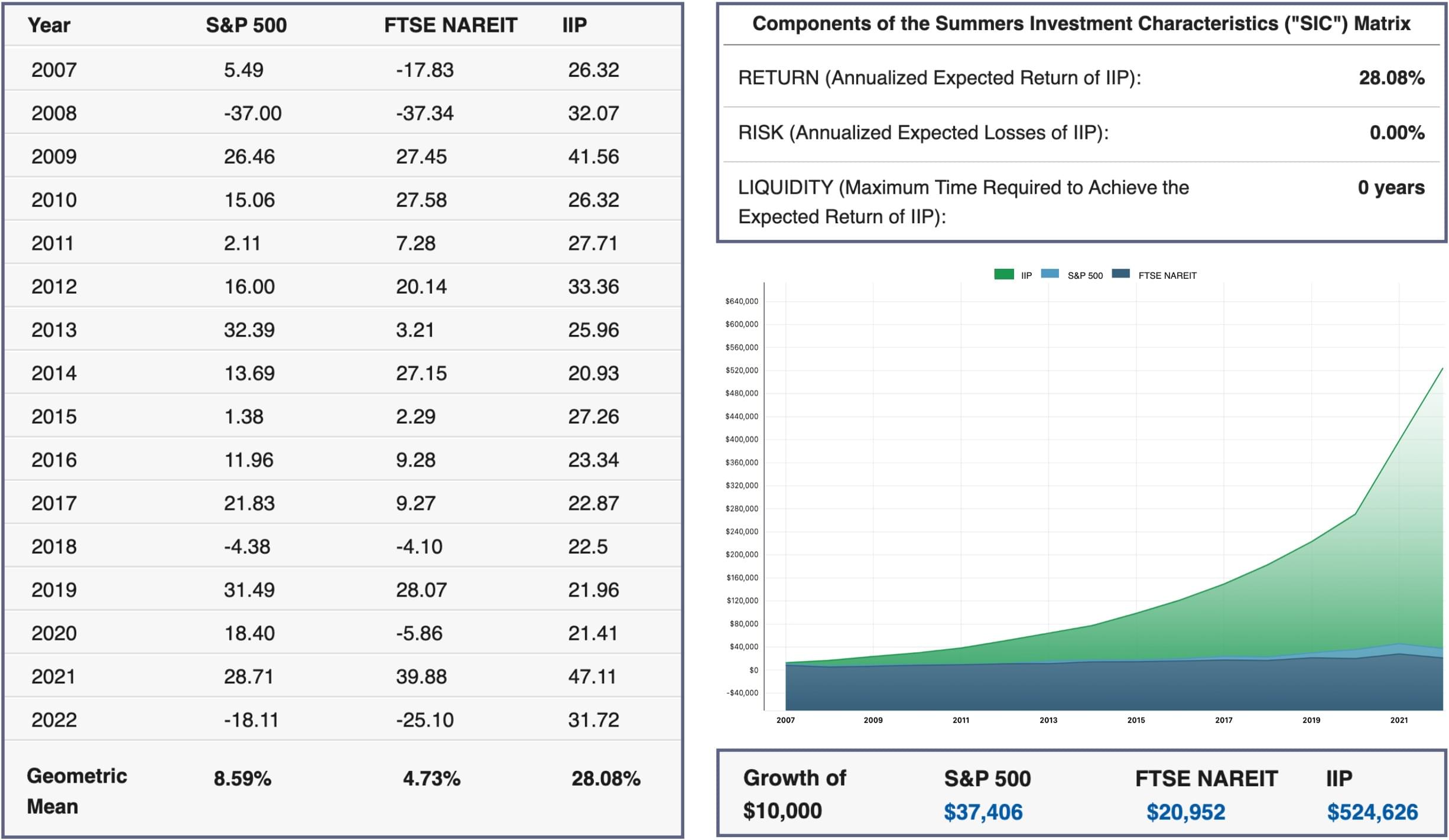
Keating and Shadwick’s Omega ratio captures all statistical moments of return distributions but has practical limitations with respect to portfolio optimization. Kapsos et al. simplified the Omega ratio into an expression with better practical application, but its focus as a portfolio optimization tool represents a trade-off with respect to absolute risk-adjusted performance measurement. First, we've transformed the Kapsos form of the Omega ratio in an analogous manner to what Modigliani did with the Sharpe ratio to create an intuitive percentage output scaled against the market. Second, we’ve deconstructed the Kapsos form of Omega to create a 3 x 1 matrix that measures and intuitively communicates the three fundamental characteristics that define an investment: risk, return, and liquidity.
Be a Better Fiduciary: Private Structured Products & Quantitative Risk Analytics for Financial Advisors
February 2018
(This paper details the core philosophy behind our use of bespoke private structured products. While originally framed for financial advisors, its central argument on the duties of a modern fiduciary is directly applicable to institutional allocators. It establishes the 'why' for this critical component of our platform. The specific 'how'—the proprietary engineering of these solutions—is now governed by the more advanced frameworks detailed in our core research, such as the Summers Measure and the SIC Matrix.)
Most financial advisors adhere to a very traditional asset allocation model built entirely upon public securities. Outside of the fact that a set of relatively vague, qualitative criteria govern the literal value of their clients’ life work, the substance upon which those models are predicated is a set of assets completely dependent upon schizophrenic secondary markets...
Investment Banking for Private Real Estate Operators
June 2017
Investment banks are intermediaries that, amongst many other functions, help typically large companies raise capital by advising on and underwriting new securities issues. To prepare for a new issue of securities, investment banks first advise their clients on considerations such as capital structure (how much debt vs. equity should be issued; what types of equity and debt should be issued, etc.), the strategic use of other financial instruments (such as warrants), and...
Investment Clubs: Gain the Exclusive Access of the Top 1%
May 2017
There is a little-known solution that can afford non-accredited investors the opportunity to participate in the exclusive securities offerings of hedge funds and invest like the top one percent: the investment club. An investment club is a business entity structured as either a general partnership or LLC in which all members (owners) are also managers who participate by vote in determining the investment decisions of the club; because all owners actively participate...
Constructing Alpha: An Introduction to the Fundamentals of Risk
April 2017
Every investor — from the guy who bets on physical currency by hiding it under his mattress to Ray Dalio — is concerned with risk. Somewhat surprisingly, despite the fact that the vast majority of people are risk averse, very few have any idea what risk actually means or how to measure it… this group includes many, if not most, financial professionals. Ironically, despite retail investors’ often stated aversion to risk, they tend to solely focus on the projected return...
From Wall Street to Main Street
July 2016
Most real estate investors face the nearly impossible task of competing for the few quality deals in their market against tens, if not hundreds, of deep-pocketed, well-connected and established investors already there. To survive, new and undercapitalized investors are forced to work many fruitless hours blindly mailing, calling, driving and knocking on random doors to find whatever scraps may be left over. After all this effort, in the rare instance a good deal is finally secured...
Introduction to Options in Real Estate
January 2015
One of most prolific and powerful tools of “creative” finance in real estate is the lease-option, but this tool represents only the proverbial tip of the iceberg when it comes to the most powerful breed of derivatives in the investing world, options. There are two basic types of options: the call option (or “call”) and the put option (or “put”). A call is what is utilized in the traditional lease-option; the put, on the other hand, is virtually unheard of in the world or real estate. An option...
Determining Equilibrium Value for Residential Real Estate
March 2013
One of the most pervasive challenges facing the residential real estate market is the determination of property values. As a result of TARP and other federal subsidies to institutional mortgage lenders, in addition to administrative incompetence, the foreclosure pipeline has been clogged. The expected glut of inventory resulting from the mortgage and financial crisis has yet to materialize, and correspondingly, prices have been lifted by artificially limited supply...
Deciphering Monetary Policy as a Means to Beat the Market
October 2012
(This paper details the first-principles critique of the post-1971 monetary order that serves as the foundation of our institutional worldview. While our tactical implementation has since evolved into a comprehensive OCIO platform, the core diagnosis of systemic risk articulated in this document remains our unwavering guide.)
Monetary policy and its effect on the markets can often seem as an impossibly complex, if not opaque dynamic. The market obviously responds, and most often in a seemingly positive manner, to the actions taken by the Federal Reserve System and statements by its chairman, Ben Bernanke… but how and why, and what are the less obvious effects of a centralized monetary system...
Consonance vs. Dissonance: A Physical Description
October 1998
Waveform superposition is applied to the complete set of just and equal-temperament diatonic intervals and triads to examine the relationship between beat structure and perceived consonance. Beat-frequency arguments have historically been considered a contributing factor to the consonance-dissonance distinction but not a sufficient one. This paper argues that the envelope periodicity of the superposed waveform, taken on its own, provides a consistent physical basis for classifying intervals as consonant or dissonant across registers. When the envelope frequency falls below the range of audible pitch, the envelope is perceived as amplitude modulation rather than as tone, producing the auditory roughness associated with dissonance. This mechanism accounts for the register-dependent dissonance of the fourth and the major and minor thirds in the low bass, where their envelope frequencies (f/3, f/4, and f/5 respectively) fall below the threshold of pitch perception. Computational results are presented for both just tuning and equal temperament, with extensions to common triads.
ADAGIO INSTITUTE, INC. © 2025 All Rights Reserved
5100 Westheimer Rd, Ste 115 • Houston, Texas 77056